Skip to content
delhi, Delhi, 110034

Business hours

SIP & Mutual Funds Investment Services – Finguide Buddy

Monday
24 hours
Tuesday
24 hours
Wednesday
24 hours
Thursday
24 hours
Friday
24 hours
Saturday
24 hours
Sunday
24 hours

You can anytime during the day with your query.

9891645052

Latest Posts & Updates

Fresh stories, announcements and offers about Investment Company, Finance broker, Investment service, straight from our business.

Keep your emotions away from Investing through SIPs

Greed and Fear in Market Cycles Human beings are guided by 2 extreme emotions "Greed" and "Fear", which prevent them from taking sound investment decisions. When there are excesses in the stock market, Greed sets in, which in turn results in major correction, thereby triggering the Fear psychology. Most of the investors are trapped in the greed and fear cycles by buying in greed and selling in fear, resulting in a bad investment experience. Source : HDFC Mutual Fund

Keep your emotions away from Investing through SIPs post imageRead full post

What Are Systematic Investment Plans?

A Systematic Investment Plan is a regular and disciplined way of investing in mutual funds. It allows an investor to contribute a fixed amount at regular intervals and slowly build wealth over time. This planned approach helps investors stay consistent and avoid the pressure of timing the market. A Systematic Investment Plan works in a manner similar to a Bank Recurring Deposit, where money is invested regularly. The amount invested is directed into one or multiple mutual fund schemes chosen by the investor. Over time, these regular contributions help create a structured and goal-oriented investment habit. Systematic Investment Plans are considered one of the best ways to invest in a mutual fund, as they help investors benefit from market fluctuations, promote financial discipline, and encourage long-term investing. Mutual fund investments are subject to market risks. Please read all scheme-related documents carefully before investing. Past performance does not guarantee future results. Mutual funds do not assure or guarantee any returns. Investors should consider their risk appetite and investment objectives before investing.

What Are Systematic Investment Plans? post imageRead full post

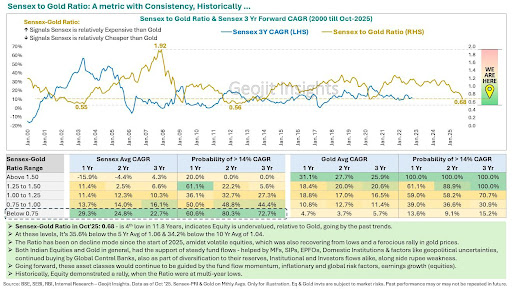
📊 Sensex to Gold Ratio – Understanding Market Trends (Data till Oct 2025)

The Sensex–Gold Ratio helps show how the equity market compares with gold over time. A high ratio means Sensex is relatively expensive, while a low ratio means Sensex is relatively cheaper versus gold. As of October 2025, the Sensex–Gold Ratio is 0.68, one of the lowest levels in nearly 12 years. This is 35.6% below the 5-year average (1.06) and 34.2% below the 10-year average (1.04). The ratio has been declining since early 2025 due to equity volatility, recovery from previous lows, and strong gold prices. Both asset classes have seen support from global central bank buying, domestic investor participation, institutional flows, geopolitical factors, and rupee weakness. Historical data (2000–2025) shows how Sensex and Gold delivered different CAGR levels across ratio ranges. Lower ratio ranges often coincided with higher historical average returns for equities, while higher ratios often coincided with stronger gold performance. These figures reflect past trends and are not indicative of future outcomes. The Sensex–Gold Ratio is a long-term metric used only for understanding historical patterns. Market performance is influenced by various economic and global factors. Data Source: BSE, SEBI, RBI, Geojit Insights. For illustration only. Past performance may or may not be repeated.

📊 Sensex to Gold Ratio – Understanding Market Trends (Data till Oct 2025) post imageRead full post

The Rule of 72: Decoding the Speed of Compounding for Investors

The Rule of 72 is a simple mental formula that helps investors estimate how long it may take for an investment to double through compound growth. Instead of using complex calculations, you simply divide 72 by the expected annual return. How it works: If an investment grows at 8%, then 72 ÷ 8 = 9 years to double. The rule works best for returns between 6% and 10%, making it useful for mutual fund SIPs, FDs, and long-term wealth planning. Formula: • Years to double = 72 ÷ Rate of return • Required return = 72 ÷ Years to double Applications: • Estimate growth potential: Helps you quickly understand how fast your money may grow. • Compare investments: You can compare doubling time across equity, debt or hybrid options. • Understand inflation: If inflation is 6%, money may lose half its value in ~12 years (72 ÷ 6). • Goal planning: Helps assess what return you may need to reach long-term goals. Conclusion: The Rule of 72 is a powerful shortcut to understand compounding and make informed investment decisions. While not exact, it helps investors visualize growth, compare options, and appreciate the long-term impact of staying invested.

The Rule of 72: Decoding the Speed of Compounding for Investors post imageRead full post

Is SIP Tax-Free? Understanding Taxation on SIP Investments

A Systematic Investment Plan (SIP) helps you invest a fixed amount regularly in mutual funds. While SIPs themselves are not taxable, the returns you earn—capital gains or IDCW—are taxed at the time of redemption. Only one category, Equity Linked Savings Scheme (ELSS), offers tax deductions under Section 80C (old regime) up to ₹1.5 lakh per year. Equity Funds: Each SIP instalment is treated as a separate investment. Short-Term Capital Gains (STCG) on units held for less than 1 year are taxed at 20%. Long-Term Capital Gains (LTCG) above ₹1.25 lakh per financial year are taxed at 12.5% without indexation. Debt Funds: For SIP investments made on or after 1 April 2023, all gains are taxed as short-term and added to your income as per slab. Older investments (before 1 April 2023) held for 3 years qualify as LTCG with 12.5% tax without any indexation benefit. ELSS SIPs: Eligible for Section 80C deduction up to ₹1.5 lakh per year with a 3-year lock-in. On redemption, LTCG rules still apply. IDCW Taxation: IDCW payouts are taxed as per your income slab. TDS of 10% applies if income exceeds ₹5,000 for residents. For NRIs, TDS is 20% + surcharge + cess. Tax-Efficient SIP Planning: – Choose funds based on time horizon – Use ELSS for tax-saving – Hold equity SIPs beyond one year for lower LTCG – Use tax-harvesting strategies – Use tools like SIP, step-up SIP, and lumpsum calculators for planning

Is SIP Tax-Free? Understanding Taxation on SIP Investments post imageRead full post

Teach Kids About Money Early — Build Strong Financial Habits for Life

Introducing your children to money management from a young age helps them develop healthy financial habits. Simple concepts like saving, budgeting and understanding the value of money prepare them to make informed decisions as adults. 🌱 Why Early Money Lessons Matter • Kids observe and learn from what they see at home • Early awareness builds confidence and responsibility • Basic financial understanding helps them grow into independent adults • Starting conversations about money early creates long-term good habits 💡 “Good money habits learned early stay for life. Rajesh Kathpalia, CFP AMFI-Registered Mutual Fund Distributor | ARN-257079 Disclaimer: This guide is for educational purposes only. It is not financial or investment advice. All investing involves risk, and children should make financial decisions only under the supervision of a parent or guardian.

Teach Kids About Money Early — Build Strong Financial Habits for Life post imageRead full post

🌟 Mutual Fund Investments – Plan Your Financial Goals

A smart and disciplined way to work towards your financial goals with professional fund management, easy investment access, and transparent processes. ⭐ Why Choose Mutual Funds? Expert & Professional Fund Management Diversified Investment Approach Simple, Convenient & Transparent ⭐ Plan Your Financial Journey Explore suitable Mutual Fund options and choose investments that align with your financial goals and preferences. 📞 Contact Us for More Details +91-9891-645052 Mutual Fund investments are subject to market risks. Please read all scheme-related documents carefully before investing.

🌟 Mutual Fund Investments – Plan Your Financial Goals post imageRead full post

📢 Latest Mutual Fund Draft Schemes Filed with SEBI

This list is updated till November 17, 2025. Date Title Nov 17, 2025 Old Bridge Flexi Cap Fund Nov 17, 2025 Union Consumption Fund Nov 14, 2025 Edelweiss Gold ETF FOF Nov 14, 2025 Edelweiss Silver ETF FOF Nov 14, 2025 Abakkus flexi cap fund Nov 12, 2025 Bank of India Banking & Financial Services Fund Nov 11, 2025 Tata BSE Multicap Consumption 50:30:20 Index Fund Nov 10, 2025 DSP Nifty 500 Index Fund Nov 10, 2025 DSP Nifty Next 50 ETF Nov 10, 2025 Parag Parikh Large Cap Fund Nov 07, 2025 Groww BSE Hospitals ETF FOF Nov 07, 2025 Groww BSE Hospitals ETF Nov 06, 2025 Bajaj Finserv Active Momentum Fund Nov 04, 2025 DSP Nifty Midcap 150 ETF​ Nov 04, 2025 DSP Nifty Smallcap 250 ETF Nov 04, 2025 DSP Nifty Smallcap 250 Index Fund Nov 04, 2025 DSP Nifty Midcap 150 Index Fund Nov 03, 2025 Helios Consumption Fund Oct 30, 2025 qsif Sector Rotation Long-Short Fund Oct 28, 2025 SBI QUALITY FUND

📢 Latest Mutual Fund Draft Schemes Filed with SEBI post imageRead full post

Did you know?

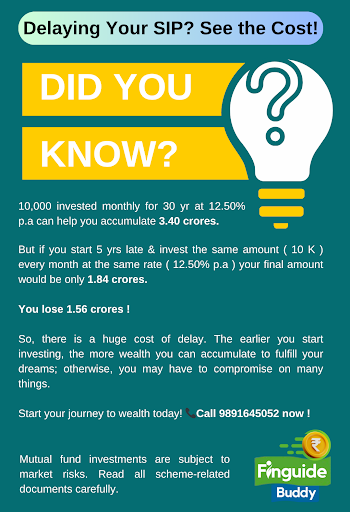
If you invest ₹10,000 monthly for 30 years at 12.5% p.a, you can accumulate ₹3.40 crores. But if you start just 5 years late, and invest the same amount at the same rate… Your final amount would be only ₹1.84 crores. 💥 You lose ₹1.56 crores — just because of a delay! There is a huge cost of delay. The earlier you start investing, the more wealth you can build to fulfil your dreams. Otherwise, you may have to compromise later. 📞 Start your SIP now and secure your future! Reply “Start SIP” or call 9891645052. Mutual Fund investments are subject to market risks. Read all scheme-related documents carefully. Finguide Buddy || AMFI-Registered Mutual Fund Distributor ( ARN-257079) Mutual Fund investments are subject to market risks. Read all scheme-related documents carefully before investing.

Did you know? post imageRead full post