Skip to content
delhi, Delhi, 110034

Business hours

SIP & Mutual Funds Investment Services – Finguide Buddy

Monday
24 hours
Tuesday
24 hours
Wednesday
24 hours
Thursday
24 hours
Friday
24 hours
Saturday
24 hours
Sunday
24 hours

You can anytime during the day with your query.

9891645052

Latest Posts & Updates

Fresh stories, announcements and offers about Investment Company, Finance broker, Investment service, straight from our business.

🌟 DID YOU KNOW? 🌟

If your monthly expenses are ₹50,000 today, you may need ₹1,75,000 per month after 25 years just to maintain the same lifestyle (at 5% inflation)! 📈💸 This is why smart investors start SIP for retirement planning early. Small disciplined investments today = Stress-free lifestyle tomorrow. Build your Retirement SIP Plan now. Want to know how much YOU should invest? Reply “Retirement SIP” 💬 Finguide Buddy || AMFI-Registered Mutual Fund Distributor ( ARN-257079) Mutual Fund investments are subject to market risks. Read all scheme-related documents carefully before investing.

🌟 DID YOU KNOW? 🌟 post imageRead full post

🌟 DID YOU KNOW? 🌟

Your child’s education that costs ₹40 lakh today could cost ₹96 lakh after 18 years (just at 5% inflation) ! 🎓📈 That’s why the smartest parents start SIP early. Small monthly investments today = Big financial security tomorrow. Start a SIP for your child’s future education today. Want to know how much YOU should invest? Reply “Plan My SIP” 💬 Finguide Buddy || AMFI-Registered Mutual Fund Distributor ( ARN-257079) Mutual Fund investments are subject to market risks. Read all scheme-related documents carefully before investing.

🌟 DID YOU KNOW? 🌟 post imageRead full post

Why “Time in the Market” Matters More Than “Timing the Market” 📈

This chart clearly shows how long-term investing creates far greater wealth than trying to predict market highs and lows. If an investor had simply stayed invested in the Nifty 50 since 1995, ₹10 lakh could have grown to ₹2.57 crore. But missing just the 5 best market days would reduce the value by almost 40% — and missing the 30 best days cuts the wealth drastically. ⏳ Key Insight: Staying invested through market ups and downs helps you capture the most powerful growth days — which often come right after market corrections. 💡 What This Means for You: Don’t try to time the market Maintain long-term discipline Volatility is normal, but compounding rewards patience Long-term investing = Higher chances of wealth creation. Mutual fund investments are subject to market risks. Please read all scheme-related documents carefully

Why “Time in the Market” Matters More Than “Timing the Market” 📈 post imageRead full post

Sir John Templeton’s Rule No. 16: Do not be fearful or negative too often

Do not be fearful or negative too often. For over 100 years, optimists have ultimately succeeded in U.S. stocks. Even during difficult periods such as the 1970s, many professional money managers — and individual investors — made money, especially in smaller companies. There will always be corrections, and occasionally even crashes. But over time, studies show that stocks tend to move up… and up… and up. With the fall of communism and the reduced threat of nuclear war, the U.S. and an increasingly united Europe may be entering one of the most promising periods in their history. As global economies become more integrated and interdependent, and as communication becomes easier and cheaper, business activity is likely to expand. Trade and travel will grow, wealth will increase, and stock prices should rise along with it. By the time the 21st century begins, there is at least an even chance that the Dow Jones Industrials could reach 6,000 or more. Other indexes may rise even faster. Despite current gloom about the economy or the future, more people will have more money than ever before — and much of it will be invested in stocks. And through all of this, the essential rule for building wealth in the stock market will remain the same: Buy low, sell high. Mutual Fund investments are subject to market risks, read all scheme related documents carefully.

Sir John Templeton’s Rule No. 16: Do not be fearful or negative too often post imageRead full post

Sir John Templeton’s Rule No. 15 -There’s no free lunch

This principle covers an endless list of cautions. Never invest on sentiment. The company that gave you your first job, built your first car, or sponsored a favorite old TV show may be a fine company — but that doesn’t automatically make its stock a fine investment. Even if the business is excellent, the stock price may be too high. Never invest in an initial public offering (IPO) just to “save” the commission. The commission is already built into the price — which is one reason many new stocks decline after listing. This doesn’t mean you should never buy an IPO; just don’t buy it for the wrong reason. Never invest solely based on a tip. It may sound obvious, but many well-educated and successful investors still fall for tips. A tip feels psychologically compelling — it creates an illusion of inside information or a shortcut to quick profits. But investing based on tips is one of the fastest ways to make costly mistakes.

Sir John Templeton’s Rule No. 15 -There’s no free lunch post imageRead full post

Sir John Templeton’s Rule No. 14: An investor who has all the answers doesn’t even understand all…

Sir John Templeton’s Rule No. 14: An investor who has all the answers doesn’t even understand all the questions A cocksure approach to investing will lead—probably sooner rather than later—to disappointment, if not outright disaster. Even if we can identify a handful of timeless investing principles, we cannot apply these rules to an unchanging world. The universe of investments, the economic landscape, and the political environment are constantly evolving. Everything is in a state of change. The wise investor understands that success is not about having all the answers—it's about continually seeking new answers to new questions.

Sir John Templeton’s Rule No. 14: An investor who has all the answers doesn’t even understand all… post imageRead full post

Sir John Templeton’s Rule No. 13: Outperforming the market is a difficult task

The challenge is not simply making better investment decisions than the average investor. The real challenge is making investment decisions that are better than those of the professionals who manage the big institutions. Remember, the unmanaged market indexes such as the S&P 500 don’t pay commissions to buy and sell stock. They don’t pay salaries to securities analysts or portfolio managers. And, unlike the unmanaged indexes, investment companies are never 100% invested, because they need to have cash on hand to redeem shares. So any investment company that consistently outperforms the market is actually doing a much better job than you might think. And if it not only consistently outperforms the market, but does so by a significant degree, it is doing a superb job

Sir John Templeton’s Rule No. 13: Outperforming the market is a difficult task post imageRead full post

Sir John Templeton’s Rule No. 11: Learn from your mistakes

The only way to avoid mistakes is not to invest—which is the biggest mistake of all. So forgive yourself for your errors. Don’t become discouraged, and certainly don’t try to recoup your losses by taking bigger risks. Instead, turn each mistake into a learning experience. Determine exactly what went wrong and how you can avoid the same mistake in the future. The investor who says, “This time is different,” when in fact it’s virtually a repeat of an earlier situation, has uttered among the four most costly words in the annals of investing. The big difference between those who are successful and those who are not is that successful people learn from their mistakes and the mistakes of others.

Sir John Templeton’s Rule No. 11: Learn from your mistakes post imageRead full post

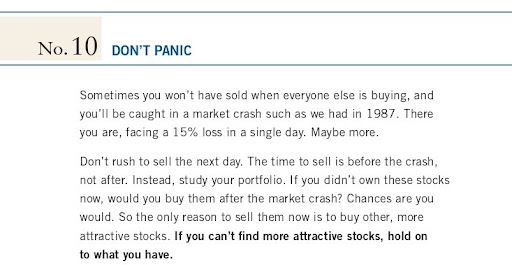
Sir John Templeton’s Rule No. 10: Don’t panic

Sometimes you won’t have sold when everyone else is buying, and you’ll be caught in a market crash such as we had in 1987. There you are, facing a 15% loss in a single day. Maybe more. Don’t rush to sell the next day. The time to sell is before the crash, not after. Instead, study your portfolio. If you didn’t own these stocks now, would you buy them after the market crash? Chances are you would. So the only reason to sell them now is to buy other, more attractive stocks. If you can’t find more attractive stocks, hold on to what you have.

Sir John Templeton’s Rule No. 10: Don’t panic post imageRead full post

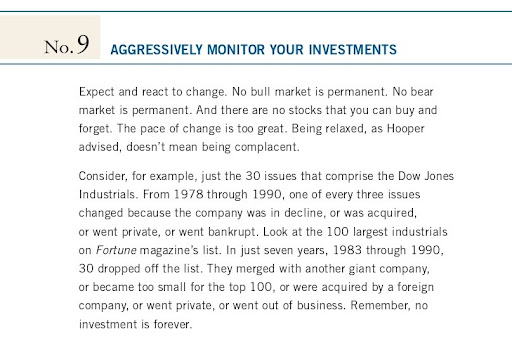
Sir John Templeton’s Rule No. 9: Aggressively monitor your investments

Expect and react to change. No bull market is permanent. No bear market is permanent. And there are no stocks that you can buy and forget. The pace of change is too great. Being relaxed, as Hooper advised, doesn’t mean being complacent. Consider, for example, just the 30 issues that comprise the Dow Jones Industrials. From 1978 through 1990, one of every three issues changed because the company was in decline, or was acquired, or went private, or went bankrupt. Look at the 100 largest industrials on Fortune magazine’s list. In just seven years, 1983 through 1990, 30 dropped off the list. They merged with another giant company, or became too small for the top 100, or were acquired by a foreign company, or went private, or went out of business. Remember, no investment is forever.

Sir John Templeton’s Rule No. 9: Aggressively monitor your investments post imageRead full post

Sir John Templeton’s Rule No. 8: Do your homework or hire wise experts to help you

People will tell you: Investigate before you invest. Listen to them. Study companies to learn what makes them successful. Remember, in most instances, you are buying either earnings or assets. In free-enterprise nations, earnings and assets together are major influences on the price of most stocks. The earnings on stock market indexes—the fabled Dow Jones Industrials, for example—fluctuate around the replacement book value of the shares of the index. (That’s the money it would take to replace the assets of the companies making up the index at today’s costs.) If you expect a company to grow and prosper, you are buying future earnings. You expect that earnings will go up, and because most stocks are valued on future earnings, you can expect that the stock price may rise also. If you expect a company to be acquired or dissolved at a premium over its market price, you may be buying assets. Years ago Forbes regularly published lists of these so-called “loaded laggards.” But remember, there are far fewer of these companies today. Raiders have swept through the marketplace over the past 10 to 15 years: Be very suspicious of what they left behind.

Sir John Templeton’s Rule No. 8: Do your homework or hire wise experts to help you post imageRead full post