Skip to content
delhi, Delhi, 110034

Business hours

SIP & Mutual Funds Investment Services – Finguide Buddy

Monday
24 hours
Tuesday
24 hours
Wednesday
24 hours
Thursday
24 hours
Friday
24 hours
Saturday
24 hours
Sunday
24 hours

You can anytime during the day with your query.

9891645052

Latest Posts & Updates

Fresh stories, announcements and offers about Investment Company, Finance broker, Investment service, straight from our business.

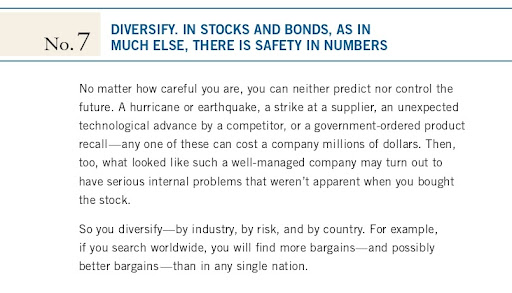
Sir John Templeton’s Rule No. 7: Diversify — In stocks and bonds, as in much else, there is safet…

Sir John Templeton’s Rule No. 7: Diversify — In stocks and bonds, as in much else, there is safety in numbers No matter how careful you are, you can neither predict nor control the future. A hurricane or earthquake, a strike at a supplier, an unexpected technological advance by a competitor, or a government-ordered product recall—any one of these can cost a company millions of dollars. Then, too, what looked like such a well-managed company may turn out to have serious internal problems that weren’t apparent when you bought the stock. So you diversify—by industry, by risk, and by country. For example, if you search worldwide, you will find more bargains—and possibly better bargains—than in any single nation.
Sir John Templeton’s Rule No. 7: Diversify — In stocks and bonds, as in much else, there is safet… post imageRead full post

Sir John Templeton’s Rule No. 6: Buy value, not market trends or the economic outlook

A wise investor knows that the stock market is really a market of stocks. While individual stocks may be pulled along momentarily by a strong bull market, ultimately it is the individual stocks that determine the market, not vice versa. All too many investors focus on the market trend or economic outlook. But individual stocks can rise in a bear market and fall in a bull market. The stock market and the economy do not always march in lock step. Bear markets do not always coincide with recessions, and an overall decline in corporate earnings does not always cause a simultaneous decline in stock prices. So buy individual stocks, not the market trend or economic outlook.

Sir John Templeton’s Rule No. 6: Buy value, not market trends or the economic outlook post imageRead full post

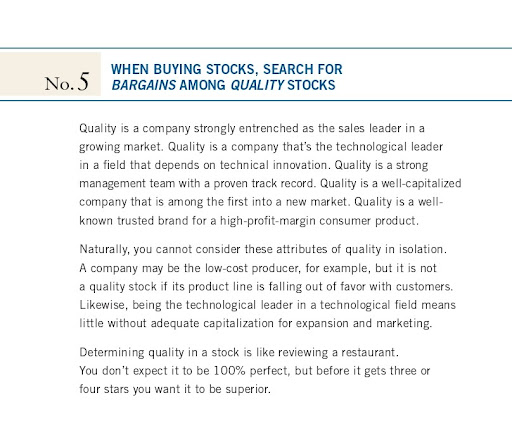
Sir John Templeton’s Rule No. 5: When Buying Stocks, Search for Bargains Among Quality Stocks

Quality is a company strongly entrenched as the sales leader in a growing market. Quality is a company that’s the technological leader in a field that depends on technical innovation. Quality is a strong management team with a proven track record. Quality is a well-capitalized company that is among the first into a new market. Quality is a well-known trusted brand for a high-profit-margin consumer product. Naturally, you cannot consider these attributes of quality in isolation. A company may be the low-cost producer, for example, but it is not a quality stock if its product line is falling out of favor with customers. Likewise, being the technological leader in a technological field means little without adequate capitalization for expansion and marketing. Determining quality in a stock is like reviewing a restaurant. You don’t expect it to be 100% perfect, but before it gets three or four stars you want it to be superior.

Sir John Templeton’s Rule No. 5: When Buying Stocks, Search for Bargains Among Quality Stocks post imageRead full post

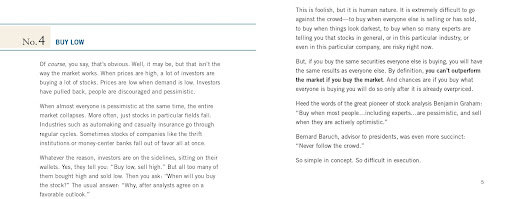
Sir John Templeton’s Rule No. 4: Buy low

Of course, you say, that’s obvious. Well, it may be, but that isn’t the way the market works. When prices are high, a lot of investors are buying a lot of stocks. Prices are low when demand is low. Investors have pulled back, people are discouraged and pessimistic. Whatever the reason, investors are on the sidelines, sitting on their wallets. Yes, they tell you: “Buy low, sell high.” But all too many of them bought high and sold low. Then you ask: “When will you buy the stock?” The usual answer: “Why, after analysts agree on a favorable outlook.” This is foolish, but it is human nature. It is extremely difficult to go against the crowd—to buy when everyone else is selling or has sold, to buy when things look darkest, to buy when so many experts are telling you that stocks in general, or in this particular industry, or even in this particular company, are risky right now. But, if you buy the same securities everyone else is buying, you will have the same results as everyone else. By definition, you can’t outperform the market if you buy the market. And chances are if you buy what everyone is buying you will do so only after it is already overpriced. Heed the words of the great pioneer of stock analysis Benjamin Graham: “Buy when most people…including experts…are pessimistic, and sell when they are actively optimistic.” Bernard Baruch, advisor to presidents, was even more succinct: “Never follow the crowd.”

Sir John Templeton’s Rule No. 4: Buy  low post imageRead full post

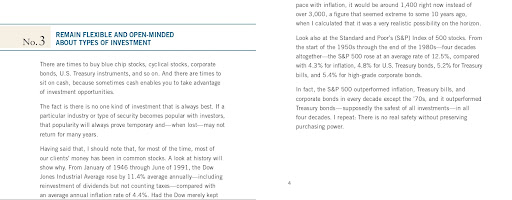
Sir John Templeton’s Rule No. 3:

Remain flexible and open-minded about types of investment There are times to buy blue chip stocks, cyclical stocks, corporate bonds, U.S. Treasury instruments, and so on. And there are times to sit on cash, because sometimes cash enables you to take advantage of investment opportunities. The fact is there is no one kind of investment that is always best. If a particular industry or type of security becomes popular with investors, that popularity will always prove temporary and—when lost—may not return for many years. Having said that, I should note that, for most of the time, most of our clients’ money has been in common stocks. A look at history will show why. From January of 1946 through June of 1991, the Dow Jones Industrial Average rose by 11.4% average annually—including reinvestment of dividends but not counting taxes—compared with an average annual inflation rate of 4.4%. Had the Dow merely kept pace with inflation, it would be around 1,400 right now instead of over 3,000, a figure that seemed extreme to some 10 years ago, when I calculated that it was a very realistic possibility on the horizon. Look also at the Standard and Poor’s (S&P) Index of 500 stocks. From the start of the 1950s through the end of the 1980s—four decades altogether—the S&P 500 rose at an average rate of 12.5%, compared with 4.3% for inflation, 4.8% for U.S. Treasury bonds, 5.2% for Treasury bills, and 5.4% for high-grade corporate bonds.

Sir John Templeton’s Rule No. 3:  post imageRead full post

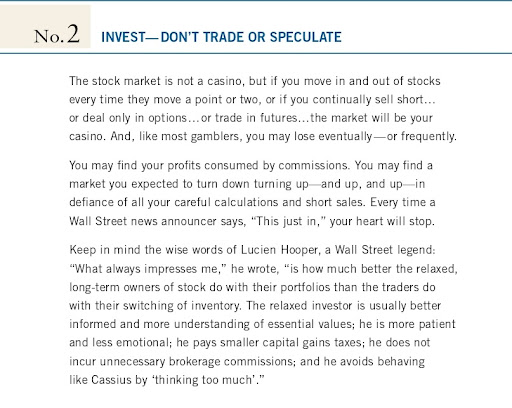
Sir John Templeton’s Rule No. 2: Invest — don’t trade or speculate

The stock market is not a casino, but if you move in and out of stocks every time they move a point or two, or if you continually sell short…or deal only in options…or trade in futures…the market will be your casino. And, like most gamblers, you may lose eventually—or frequently. You may find your profits consumed by commissions. You may find a market you expected to turn down turning up—and up, and up—in defiance of all your careful calculations and short sales. Every time a Wall Street news announcer says, “This just in,” your heart will stop. Keep in mind the wise words of Lucien Hooper, a Wall Street legend: “What always impresses me,” he wrote, “is how much better the relaxed, long-term owners of stock do with their portfolios than the traders do with their switching of inventory. The relaxed investor is usually better informed and more understanding of essential values; he is more patient and less emotional; he pays smaller capital gains taxes; he does not incur unnecessary brokerage commissions; and he avoids behaving like Cassius by ‘thinking too much’.”

Sir John Templeton’s Rule No. 2: Invest — don’t trade or speculate post imageRead full post

Sir John Templeton’s Rule No. 1: Invest for maximum total real return

This means the return on invested dollars after taxes and after inflation. This is the only rational objective for most long-term investors. Any investment strategy that fails to recognize the insidious effect of taxes and inflation fails to recognize the true nature of the investment environment and thus is severely handicapped. It is vital that you protect purchasing power. One of the biggest mistakes people make is putting too much money into fixed-income securities. Today’s dollar buys only what 35 cents bought in the mid-1970s, what 21 cents bought in 1960, and what 15 cents bought after World War II. U.S. consumer prices have risen every one of the last 38 years. If inflation averages 4%, it will reduce the buying power of a $100,000 portfolio to $68,000 in just 10 years. In other words, to maintain the same buying power, that portfolio would have to grow to $147,000 — a 47% gain simply to remain even over a decade. And this doesn’t even count taxes. "Diversify. In stocks and bonds, as in much else, there is safety in numbers."

Sir John Templeton’s Rule No. 1: Invest for maximum total real return post imageRead full post

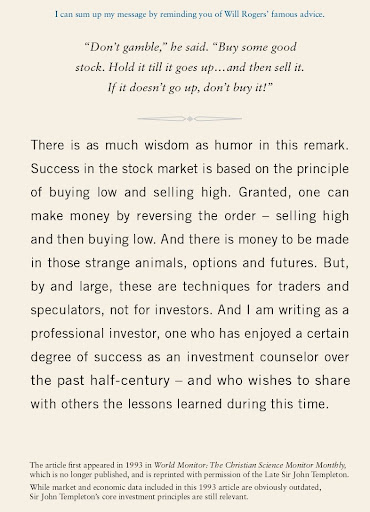
I can sum up my message by reminding you of Will Rogers’ famous advice.

“Don’t gamble,” he said. “Buy some good stock. Hold it till it goes up…and then sell it. If it doesn’t go up, don’t buy it!” - by Sir John Templeton (Franklin Templeton ) There is as much wisdom as humor in this remark. Success in the stock market is based on the principle of buying low and selling high. Granted, one can make money by reversing the order – selling high and then buying low. And there is money to be made in those strange animals, options and futures. But, by and large, these are techniques for traders and speculators, not for investors. And I am writing as a professional investor, one who has enjoyed a certain degree of success as an investment counselor over the past half-century – and who wishes to share with others the lessons learned during this time. The article first appeared in 1993 in World Monitor: The Christian Science Monitor Monthly, which is no longer published, and is reprinted with permission of the Late Sir John Templeton. While market and economic data included in this 1993 article are obviously outdated, Sir John Templeton’s core investment principles are still relevant.

I can sum up my message by reminding you of Will Rogers’ famous advice. post imageRead full post

Indian IT companies have been among the most neglected segments in this market cycle. The key rea…

Indian IT companies have been among the most neglected segments in this market cycle. The key reasons are weaker growth and limited visibility, along with the absence of the “AI froth” that has boosted global tech valuations. This is not the first time such skepticism has emerged. A similar phase played out in 2016–2017, when clients shifted from traditional outsourcing to digital and cloud. Investors worried about disruption, and margins and growth did weaken. But Indian IT firms adopted these technologies, tweaked delivery models, and returned to a steadier growth path. Businesses evolve, and legacy sectors like IT services have done so repeatedly. The AI-led transition may look distant today, but it is early to doubt their ability to adapt. Even after the recent derating, the sector still shows solid ROEs, disciplined capital allocation and reasonable valuations, which makes it relatively attractive versus the broader market. A 15% or so price fall can make this sector attractive on an absolute basis. Till such times a systematic investing approach seems logical.

Indian IT companies have been among the most neglected segments in this market cycle. The key rea… post imageRead full post

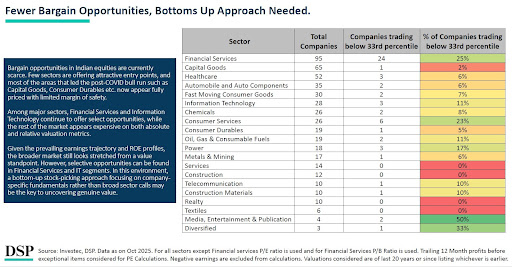
Fewer Bargain Opportunities, Bottoms Up Approach Needed :

Bargain opportunities in Indian equities are currently scarce. Few sectors are offering attractive entry points, and most of the areas that led the post-COVID bull run such as Capital Goods, Consumer Durables etc. now appear fully priced with limited margin of safety. Among major sectors, Financial Services and Information Technology continue to offer select opportunities, while the rest of the market appears expensive on both absolute and relative valuation metrics. Given the prevailing earnings trajectory and ROE profiles, the broader market still looks stretched from a value standpoint. However, selective opportunities can be found in Financial Services and IT segments. In this environment, a bottom-up stock-picking approach focusing on company-specific fundamentals rather than broad sector calls may be the key to uncovering genuine value.

Fewer Bargain Opportunities, Bottoms Up Approach Needed : post imageRead full post