Skip to content
delhi, Delhi, 110034

Business hours

SIP & Mutual Funds Investment Services – Finguide Buddy

Monday
24 hours
Tuesday
24 hours
Wednesday
24 hours
Thursday
24 hours
Friday
24 hours
Saturday
24 hours
Sunday
24 hours

You can anytime during the day with your query.

9891645052

Latest Posts & Updates

Fresh stories, announcements and offers about Investment Company, Finance broker, Investment service, straight from our business.

SEBI Opens Special Re-lodgement Window for Physical Share Transfers (05 Feb 2026 – 04 Feb 2027)

The Securities and Exchange Board of India (SEBI) has opened another special one-year window from 5 February 2026 to 4 February 2027 to re-lodge transfer requests of physical shares executed before 1 April 2019. This move provides relief to investors who missed earlier deadlines. Although physical share transfers were discontinued from April 2019, transfer deeds that were lodged earlier but rejected due to deficiencies can now be processed, provided the deed was executed before the cut-off date and original certificates are available. Fresh lodgements meeting these conditions are also permitted. The processing will be subject to strict documentation and verification. The window also allows simultaneous transfer and dematerialisation. However, disputed cases and securities already transferred to the Investor Education and Protection Fund (IEPF) are excluded. Detailed identity and signature verification procedures will apply, including issuance of public notice where transferors are untraceable. Transfers must be completed within 70 days from the date of receipt of complete documents and will carry a one-year lock-in to prevent fraud.


SEBI Opens Special Re-lodgement Window for Physical Share Transfers (05 Feb 2026 – 04 Feb 2027) post imageRead full post

📅 Ravi in 2025:

“I’ll start investing next year…” ⏳ Ravi in 2045: “I wish I had started earlier…” 💡 The difference between regret and financial freedom is just one decision — starting today. A Systematic Investment Plan (SIP) helps you: ✅ Start with a small monthly amount ✅ Build long-term wealth through compounding ✅ Stay disciplined despite market ups & downs ✅ Achieve goals like retirement, child education & financial independence Time in the market is more powerful than timing the market. 🌱 The best time to start investing was yesterday. 📈 The next best time is today. If you are planning for your future goals, let’s create a structured Mutual Fund SIP plan aligned with your risk profile and financial objectives. — Finguide Buddy

📅 Ravi in 2025: post imageRead full post

💡 Why choose a Mutual Fund Distributor in your wealth creation journey?

Markets offer many options, but selecting suitable schemes and staying invested with discipline is important. ✅ Assistance in selecting appropriate mutual fund schemes ✅ Goal-based investment approach ✅ Support during market volatility ✅ Ongoing service & transaction support 📈 Long-term wealth creation depends on discipline, patience and a structured investment approach. 🤝 If you prefer a smooth and supported investment process, a Mutual Fund Distributor can assist you throughout your journey. — Finguide Buddy Mutual Fund investments are subject to market risks. Please read all scheme related documents carefully.

💡 Why choose a Mutual Fund Distributor in your wealth creation journey? post imageRead full post

Ensuring Cash Flow After Retirement: Turning Savings into a Steady Paycheque

Retirement is often described as a second innings of life — a time to travel, pursue hobbies, and spend quality moments with family. But behind this pleasant picture lies one crucial question: Will my money provide a regular income after I stop working? Unlike salaried years, retirement comes without a monthly paycheque. Ensuring steady cash flow therefore becomes the backbone of a stress-free retired life. Why Cash Flow Matters More Than Corpus Many retirees focus on how big their retirement corpus is, but the real challenge is converting that corpus into reliable monthly income. Expenses do not stop after retirement — groceries, electricity bills, healthcare, travel and occasional emergencies continue, often rising due to inflation. A large corpus without a proper withdrawal plan can still lead to anxiety and, in extreme cases, running out of money. The Bucket Strategy: Order in Your Finances One practical way retirees can manage cash flow is through the bucket strategy. In simple terms, retirement savings are divided into different “buckets” based on time horizon and risk. Short-term bucket (0–1 year): Money meant for immediate expenses, kept in low-risk options like liquid or money market funds. Medium-term bucket (1–5 years): Funds for planned expenses, invested in relatively stable debt or hybrid funds.

Ensuring Cash Flow After Retirement: Turning Savings into a Steady Paycheque post imageRead full post

Don’t Put All Your Eggs in One Basket”: A Timeless Rule for Financial Safety

Don’t Put All Your Eggs in One Basket”: A Timeless Rule for Financial Safety The old proverb “Don’t put all your eggs in one basket” carries a simple but powerful message — if the basket falls, everything is lost. In personal finance, this wisdom is more relevant than ever, especially while managing long-term wealth and retirement savings. Many investors make the mistake of concentrating their money in a single asset — be it real estate, fixed deposits, gold, or even one type of mutual fund. While the intention is often safety or higher returns, such concentration can expose the investor to unnecessary risk. Why One Basket Is Risky Every asset class goes through cycles. Equity markets can be volatile, interest rates affect debt instruments, gold prices fluctuate, and real estate can remain illiquid for years. If all savings are tied to one asset and that asset underperforms or faces a downturn, the investor’s entire financial plan can be disturbed. For retirees, this risk is even more serious. Regular expenses continue, but income sources reduce. A fall in one concentrated investment can directly impact monthly cash flow and lifestyle.

Don’t Put All Your Eggs in One Basket”: A Timeless Rule for Financial Safety post imageRead full post

Loans Against Your NPS Account : A Simple Guide

Loans Against Your NPS Account : A Simple Guide Many investors are familiar with loans against shares or mutual funds. What fewer people know is that NPS (National Pension System) subscribers can now also access limited financial assistance against their NPS savings through regulated lenders. This facility became possible after recent reforms by PFRDA, which allow lenders to place a lien on a part of an NPS account. The change improves liquidity for subscribers while keeping their retirement planning largely intact. Here is a clear and easy explanation of how loans against NPS work, who can use them, and what to keep in mind in 2026. What Changed in NPS Rules? Under the updated PFRDA framework, NPS subscribers can take loans against up to 25% of their own contributions. Instead of withdrawing money from the account, a lender places a lien (a temporary charge) on the eligible portion of the NPS corpus. This means subscribers can meet short-term financial needs without exiting or disturbing their long-term retirement investments. What Does ‘Lien on NPS’ Mean? A lien means the lender marks a portion of your NPS contribution as security for the loan. The money is not withdrawn from your NPS account. Your NPS account continues as usual Investments remain in the market You continue to earn returns on the full corpus The lien is removed once the loan is repaid

Read full post

ETF vs Index Funds: The Hidden Costs Behind ‘Low-Cost’ Investing

ETF vs Index Funds: The Hidden Costs Behind ‘Low-Cost’ Investing Exchange Traded Funds (ETFs) are often promoted as the cheapest way to invest in the stock market due to their low expense ratios. However, a closer look shows that the actual cost of investing in ETFs can be higher than it appears, especially for long-term and small investors. A growing body of investor experience suggests that plain index mutual funds may, in many cases, be more cost-effective and convenient than ETFs, despite having a slightly higher expense ratio on paper. Here’s a simple explanation of where the hidden costs lie and who should choose what. The Invisible Costs of ETFs ETFs are traded on stock exchanges, similar to shares. While their expense ratio may be low, investors often face additional indirect costs that are not immediately visible. 1️⃣ Entry Cost Through Market Price Unlike index funds, ETFs are not bought directly from the fund house at NAV. Investors purchase them from the market. An ETF with an NAV of ₹100 may trade at ₹104–₹105 This difference acts like a hidden entry load Over time, this cost can significantly reduce returns, especially for SIP investors.

ETF vs Index Funds: The Hidden Costs Behind ‘Low-Cost’ Investing post imageRead full post

The Butterfly Effect in SIPs: When Small Decisions Create Big Wealth

A popular saying goes: a butterfly flapping its wings in one part of the world can trigger a storm elsewhere. Known as the Butterfly Effect, this idea explains how tiny actions can sometimes lead to disproportionately large outcomes. In personal finance, especially in Systematic Investment Plans (SIPs), this concept quietly plays out every day. In the world of investing, wealth is rarely created through dramatic, one‑time decisions. Instead, it is shaped by small, consistent choices — starting a little earlier, investing a little more, or increasing contributions gradually over time. These seemingly minor tweaks can compound into meaningful financial differences over the long run. The Power of a Small Change Consider two investors who begin their investment journey with the same monthly SIP amount. Both commit to discipline and long‑term investing, but one of them makes a simple adjustment — a modest annual increase in the SIP amount. Over a 20‑year period, that single decision can result in a dramatically higher corpus. In real‑world illustrations, a monthly SIP of ₹10,000 continued for two decades can grow into a substantial sum. However, increasing that SIP by just 10% every year nearly doubles the final wealth. The difference is not due to market timing or superior fund selection, but purely the result of compounding acting on a slightly higher investment base each year.

The Butterfly Effect in SIPs: When Small Decisions Create Big Wealth post imageRead full post

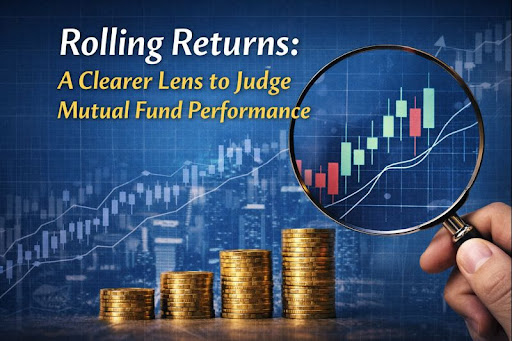
Rolling Returns: A Clearer Lens to Judge Mutual Fund Performance

Rolling Returns: A Clearer Lens to Judge Mutual Fund Performance Investors often judge mutual funds by looking at headline returns between two fixed dates. While this point‑to‑point method appears simple, it can be misleading. Market highs or lows at the beginning or end of the period may distort the real picture. This is where rolling returns offer a more balanced and insightful way to assess mutual fund performance. Rolling returns help investors understand not just how much a fund has delivered, but how consistently it has performed across different market phases. By shifting the start and end dates across multiple periods, rolling returns reduce the impact of short‑term volatility and provide a clearer picture of long‑term behaviour. What Are Rolling Returns? Rolling returns measure a mutual fund’s performance across multiple overlapping time periods rather than one fixed interval. Instead of calculating returns only from one start date to one end date, this method continuously shifts the time window—monthly, quarterly, or yearly—to capture performance under varying market conditions. This approach allows investors to see how a fund has behaved during market rallies, corrections, and periods of consolidation. As a result, rolling returns offer deeper insight into consistency and reliability.

Rolling Returns: A Clearer Lens to Judge Mutual Fund Performance post imageRead full post

Why Low Correlation Matters in Investing

In investing, risk is not just about market volatility—it is also about how different assets behave in relation to one another. This relationship, known as correlation, plays a critical role in determining how smoothly a portfolio performs across market cycles. Correlation measures whether asset classes move together or independently. When assets are highly correlated, they tend to rise and fall at the same time, increasing portfolio risk during market downturns. Low correlation, on the other hand, allows different assets to balance each other, helping reduce the overall impact of market shocks. Gold has historically demonstrated low correlation with both equity and debt. As seen in the correlation table above, equity and gold show near-zero or slightly negative correlation, while gold’s correlation with bonds remains minimal. This means gold often behaves differently when stocks or bonds experience sharp movements. Gold typically shows low correlation to equity and bonds. During periods of market stress, this correlation may even turn negative. This behaviour can help reduce portfolio drawdowns and smoothen the overall investment journey.

Why Low Correlation Matters in Investing post imageRead full post