Skip to content
delhi, Delhi, 110034

Business hours

SIP & Mutual Funds Investment Services – Finguide Buddy

Monday
24 hours
Tuesday
24 hours
Wednesday
24 hours
Thursday
24 hours
Friday
24 hours
Saturday
24 hours
Sunday
24 hours

You can anytime during the day with your query.

9891645052

Latest Posts & Updates

Fresh stories, announcements and offers about Investment Company, Finance broker, Investment service, straight from our business.

🌳 Wealth Grows in Calm

Successful investing is often less about reacting to every market movement and more about staying focused on your long-term financial goals. Markets can be volatile in the short term, but emotional decisions driven by fear or excitement may distract investors from their investment journey. A disciplined and goal-oriented approach can help investors stay committed to their financial plans. Just as a tree grows steadily over time, wealth creation is often built through patience, consistency, and a long-term perspective. Staying invested according to your financial goals and risk profile can be an important part of the wealth creation process. Whether your objective is retirement planning, children's education, wealth creation, or other life goals, having a structured investment strategy can help you stay on track. Connect with us to understand how mutual funds and SIPs can be aligned with your financial goals. Rajesh Kathpalia FINGuide Buddy AMFI Registered Mutual Fund & SIF Distributor ARN-257079 Disclaimer: Mutual Fund investments are subject to market risks. Read all scheme-related documents carefully before investing.


🌳 Wealth Grows in Calm post imageRead full post

📈 Consistency > Everything

Building wealth is not only about choosing the best investment. It is also about investing regularly and consistently every month. Markets may move up and down in the short term, but disciplined investing and staying committed to your financial goals can help you build long-term wealth. A Systematic Investment Plan (SIP) encourages regular investing and helps investors stay focused on their financial journey rather than short-term market movements. Instead of trying to time the market, focus on time in the market. Consistency, patience, and discipline are often more important than chasing the latest trends or past performance. Whether you are planning for retirement, your child's education, wealth creation, or other long-term financial goals, a structured investment approach can make a meaningful difference over time. Connect with us to understand how mutual funds and SIPs can be aligned with your financial goals. Rajesh Kathpalia FINGuide Buddy AMFI Registered Mutual Fund & SIF Distributor ARN-257079 Disclaimer: Mutual Fund investments are subject to market risks. Read all scheme-related documents carefully before investing.

📈 Consistency > Everything post imageRead full post

📊 Weekly Market Highlights | 11th April 2026

Markets continued their upward momentum this week, supported by strong macroeconomic signals and stable policy outlook. 🔹 Mutual Fund Industry Growth: AUM crossed ₹70 lakh crore in March 2026, reflecting strong investor participation and consistent inflows. 🔹 RBI Policy Update: Repo rate remains steady at 6.5%, ensuring stability in borrowing costs and supporting economic growth. 🔹 Economic Strength: Corporate tax collections surged by 15% in FY26, indicating improving business performance. 🔹 Sectoral Boost: Auto component exports grew 18%, highlighting India’s strengthening global manufacturing position. 📈 Market Snapshot: Equity indices like Sensex and Nifty gained nearly 5–6% this week, while gold and silver also showed positive traction. Crude oil, however, saw a decline.

📊 Weekly Market Highlights | 11th April 2026 post imageRead full post

Volatility Tests Minds, Not Portfolios

Market ups and downs are a natural part of investing—but what truly matters is how you respond during these phases. Many investors tend to panic when markets fall and become overconfident when markets rise. However, successful investing is not about timing the market, but about staying disciplined and consistent. Just like a game of chess, wealth creation requires patience, strategy, and a long-term vision. Short-term volatility may create noise, but it does not change the fundamentals of a well-planned investment strategy. At Finguide Buddy, we believe that investor behavior plays a bigger role than market movements. Staying invested during uncertain times can help you benefit from compounding and long-term growth opportunities. Instead of reacting emotionally, focus on your financial goals and continue your investment journey with clarity and confidence. Whether it’s through SIPs or goal-based planning, consistency is the key to building wealth over time. 📌 Stay calm. Stay disciplined. Stay invested. 👉 For assistance in selecting suitable mutual fund investments to meet your financial goals, feel free to connect with us. Disclaimer: Mutual Fund investments are subject to market risks. Read all scheme-related documents carefully before investing.

Volatility Tests Minds, Not Portfolios post imageRead full post

When war shakes markets, don’t walk away. Stay invested.

Continue your SIP and stay invested towards a financially secure future for yourself and your family with mutual fund investments. My duty is not to predict markets, my duty is to guide behaviour. Just like Krishna reminded Arjuna of his role, this is the time to stay invested, not the time to disappear. Stay Disciplined Invest Regularly Build Long-Term Wealth Disclaimer: Mutual Fund investments are subject to market risks, read all scheme related documents carefully. ARN-257079

When war shakes markets, don’t walk away. Stay invested. post imageRead full post

SOA vs Demat: How Should You Hold Your Mutual Funds?

Mutual funds in India can be held in two ways — SOA (Statement of Account) or Demat mode. In SOA mode, your mutual fund units are held directly with the AMC or RTA, and you do not need a Demat account. It also allows easy SIPs, switches, and redemptions, and usually does not involve Demat-related charges. In Demat mode, units are held in your Demat account, similar to shares. This requires a broker and Demat account, and Demat or transaction charges may apply. 💡 It’s important to know that returns, NAV, and portfolio remain exactly the same in both modes. The difference is only in the holding and transaction process. Many long-term investors commonly use SOA mode due to its flexibility and potentially lower costs. Mutual Fund investments are subject to market risks. Read all scheme-related documents carefully.

SOA vs Demat: How Should You Hold Your Mutual Funds? post imageRead full post

Question : Which 5 mutual funds are best?

Answer : There are no universally ‘best’ mutual funds. The suitability of any mutual fund depends on an investor’s financial goals, risk appetite, and investment horizon. As a Mutual Fund Distributor, I can provide general educational information about categories such as equity, debt, or hybrid funds. However, scheme-specific recommendations require proper risk profiling and suitability assessment. Mutual Fund investments are subject to market risks, and past performance does not guarantee future returns.

Question : Which 5 mutual funds are best? post imageRead full post

Save on Long-Term Capital Gains with 54EC Bonds

If you’ve sold a property and want to reduce your long-term capital gains tax, 54EC Capital Gain Bonds are a smart and legal option. These bonds are issued by government-backed institutions such as: REC Limited Power Finance Corporation (PFC) Indian Railway Finance Corporation (IRFC) Housing & Urban Development Corporation Ltd (HUDCO) Key Benefits: Investment Limit: Up to ₹50 lakh within six months of property sale. Lock-in Period: 5 years (cannot redeem or transfer before maturity). Interest Rate: Fixed at 5.25% per annum (interest is taxable). Who Can Benefit: Anyone looking to save on capital gains tax after selling property. How to Apply: Simple process, available online and offline, requiring basic documents like PAN card and address proof. 📩 To learn more or get the application form: WhatsApp: “54EC Bonds” to 9891645052 Email: ask@finguidebuddy.com

Save on Long-Term Capital Gains with 54EC Bonds post imageRead full post

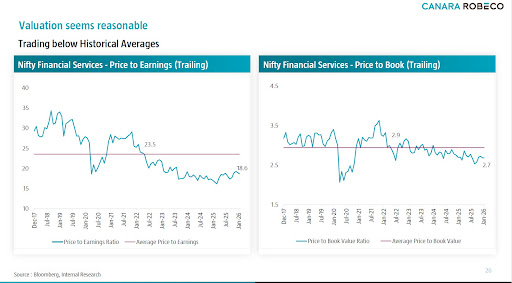
Nifty Financial Services Valuation: Trading Below Historical Averages

The chart indicates that Nifty Financial Services valuations are currently trading below their long-term historical averages, suggesting relatively reasonable pricing in the sector. As highlighted in both key valuation metrics — Price to Earnings (P/E) Ratio (Trailing) and Price to Book (P/B) Ratio (Trailing) reflect moderation compared to past peaks. Price to Earnings (P/E) Ratio – Below Long-Term Average The trailing P/E ratio is around 18.6, compared to the historical average of approximately 23.5. In previous market cycles, valuations crossed 30 during strong bull phases. The current lower P/E suggests improved earnings support and relatively comfortable valuations, which may indicate better risk-reward balance for long-term investors. Price to Book (P/B) Ratio – Moderation in Valuations The trailing P/B ratio stands near 2.7, versus its long-term average of about 2.9. Compared to earlier peaks above 3.5, current levels show valuation correction and normalization in the financial services sector. What This Means for Investors Lower P/E and P/B ratios historically signal more reasonable entry levels, especially when supported by earnings growth and sector fundamentals. The data suggests that the financial services space is not trading at overheated levels and remains aligned with sustainable valuation trends. Source: Bloomberg, Internal Research.

Nifty Financial Services Valuation: Trading Below Historical Averages post imageRead full post

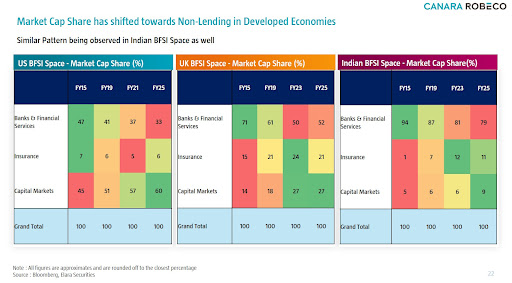
Market leadership in BFSI is shifting beyond banks: what it means for mutual fund investors

Across developed markets like the US and UK, the BFSI sector has seen a gradual shift in market capitalization from traditional banks towards insurance and capital market companies. A similar trend is now visible in India as well, where non-lending financial businesses are gaining a larger share of overall market value over time. This reflects the growing role of asset management companies, exchanges, brokers, insurers, and market-linked financial services in the economy. For mutual fund investors, this shift highlights the importance of diversification within the financial services sector. Instead of being exposed only to banks, investors can participate in the broader BFSI opportunity through mutual fund schemes that invest across banks, insurance, capital markets, and other financial services companies. This allows investors to benefit from structural changes in the financial ecosystem over the long term, aligned with their financial goals and risk profile. Mutual Fund investments are subject to market risks. Read all scheme related documents carefully.

Market leadership in BFSI is shifting beyond banks: what it means for mutual fund investors post imageRead full post

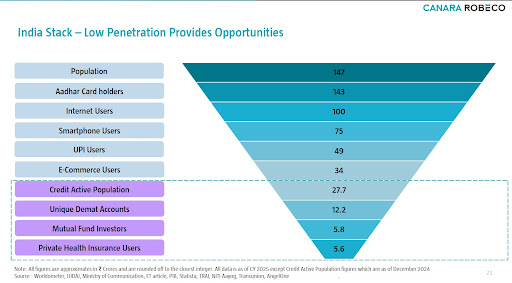
India’s digital growth is rising, but mutual fund participation is still low

India has seen rapid adoption of digital infrastructure such as Aadhaar, internet access, smartphones, and UPI. This has enabled millions of people to access financial services easily. However, when we look at actual participation in long-term financial products like demat accounts and mutual funds, the numbers are still relatively low compared to the overall population. This gap highlights a large untapped opportunity for investors to move from just using digital payments to building long-term wealth through mutual funds. With increased awareness, financial literacy, and goal-based investing, more individuals can participate in India’s growth story in a structured manner. Mutual funds offer access to professionally managed portfolios across equity, debt and hybrid categories, helping investors align their investments with their financial goals and risk profile. Mutual Fund investments are subject to market risks. Read all scheme related documents carefully.

India’s digital growth is rising, but mutual fund participation is still low post imageRead full post

Why Protecting Capital Is More Important Than Chasing High Returns

Many investors focus only on returns, but few understand how difficult it is to recover from losses. 📉 If you lose 30%, you need a 43% gain just to break even. 📉 A 50% loss requires a 100% gain to recover. 📉 A 70% loss needs a massive 233% gain to come back to zero. This clearly shows one important principle of investing: Capital protection comes first. Compounding works powerfully on gains over time, but losses damage wealth much faster. That’s why smart portfolio strategy focuses on risk management, asset allocation, and disciplined investing instead of blindly chasing high-return schemes. As rightly said: “Rule No.1: Don’t lose money. Rule No.2: Never forget Rule No.1.” At Finguide Buddy – AMFI Registered Mutual Fund Distributor, we help investors build diversified portfolios aligned with their risk profile and long-term financial goals.

Why Protecting Capital Is More Important Than Chasing High Returns post imageRead full post